

Why uPVC Doors Fail: The Hidden Lock Crisis

In a Hurry? Here's the Key Info
- Nearly half of all locksmith call-outs are uPVC doors — and it’s rarely about lost keys
- Heat and cold make uPVC frames expand and contract, misaligning the lock twice a year
- A “floppy” or stiff handle is your warning sign — act early and save around £68
- A shattered gearbox can deadlock you in or out, needing a professional to fix
- Simple seasonal maintenance (lubricate, realign, test) prevents most failures
In the world of home security, uPVC is undisputed as the most popular door in the British suburbs. However, beneath the low-maintenance exterior lies a vulnerability which can mean your uPVC won’t lock. Data from over 350,000 Keytek locksmith jobs reveals a scary reality – we’re not getting locked out from lost keys, it’s due to hardware failure.
The Leading Door Type for Failures
Out of every door serviced by a Keytek locksmith in the past 5 years, uPVC doors account for 47.7% of all jobs. If you have a uPVC door, you’re twice as likely to need a locksmith compared to if you had a wooden door.
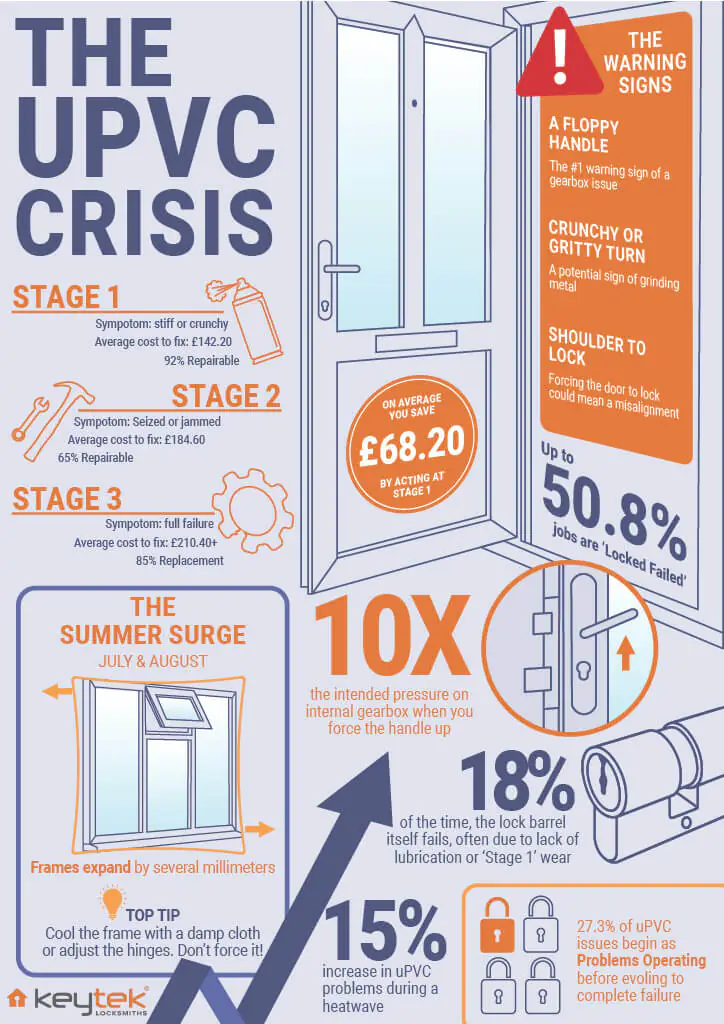
- The Mechanical Mortality Rate: In a typical locksmith job, human error is the main culprit. However, for uPVC, it’s the actual door which causes the problem. 50.8% of all uPVC jobs are caused by ‘Lock Failed’
- The ‘Lock Out’ Paradox: Unbelievably, you are more likely to be trapped inside your home by a failed uPVC lock than you are to be locked out by losing your keys.
The “Thermal Trap”: Hot and Cold Seasonality
uPVC is not absolute, in fact it’s a more rigid, durable form of plastic. But like all plastics it expands and contracts with temperature changes throughout the UK. This creates a distinct double peak of failure.
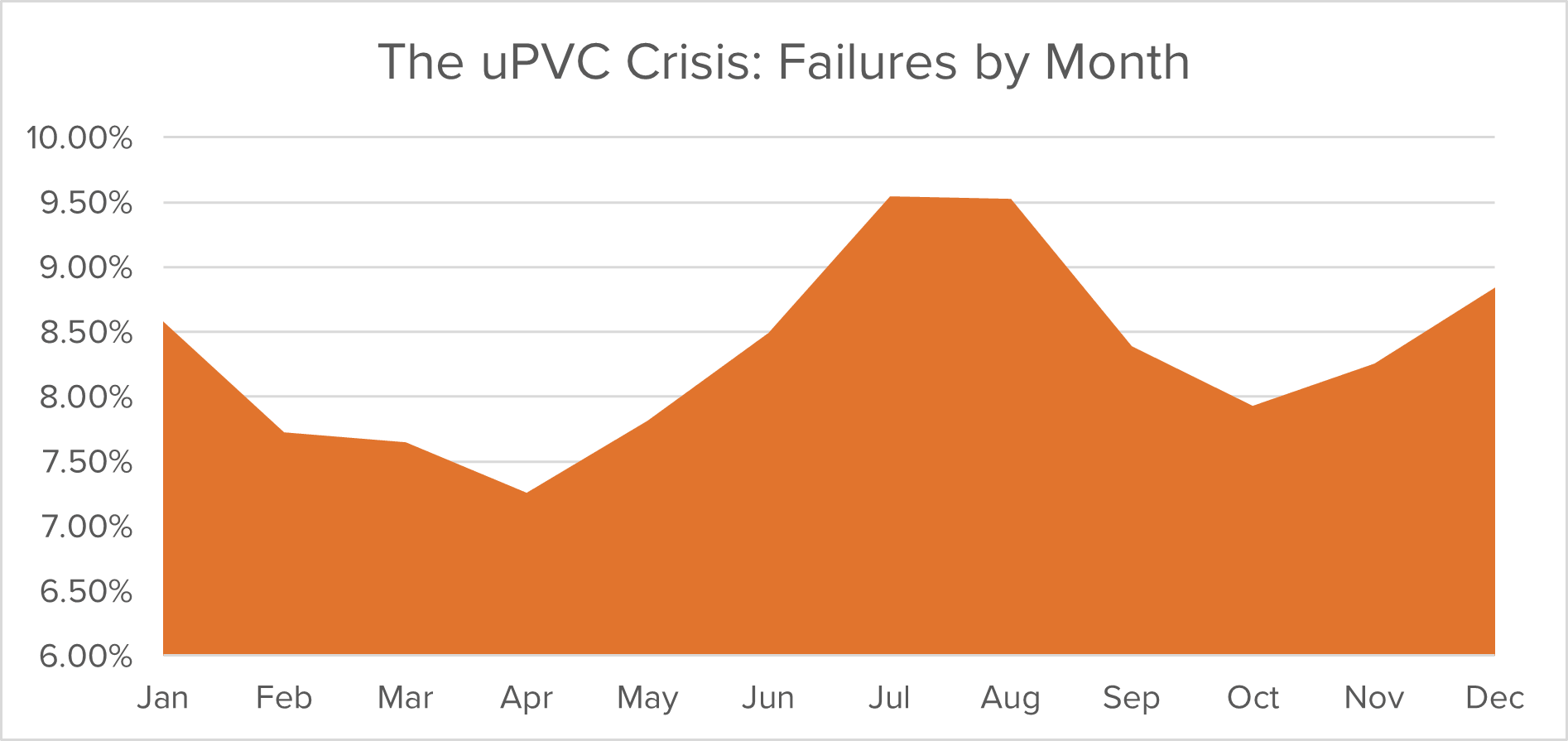
The Summer Surge (July and August)
Failures hit their peak in July (9.54%) and August (9.52%), this is because direct sunlight can cause uPVC frames to expand by several millimetres which misaligns the locking system. When you force a stiff uPVC handle to engage the lock, it can apply up to 10x the intended pressure on the internal gearbox causing it to break.
Most of the time, the issue will resolve when the door has cooled down or you can try adjusting the hinges.
The Winter Snap (December and January)
A secondary peak appears December (8.8%) and January (8.5%), this is a direct result of colder weather which causes the frame of the uPVC door to contract. As the frame, pulls away from the door, the locking points no longer meet the keeps, making the door nearly impossible to lock.
During these months, an adjustment is nearly always needed to resolve the issue.
The Price of Procrastination
Our data shows that a sticky uPVC door is a warning for your wallet. Currently 27.3% of all jobs begin as ‘problem operating’. If ignored, these inevitable evolve into a ‘Can’t Lock’ situation.
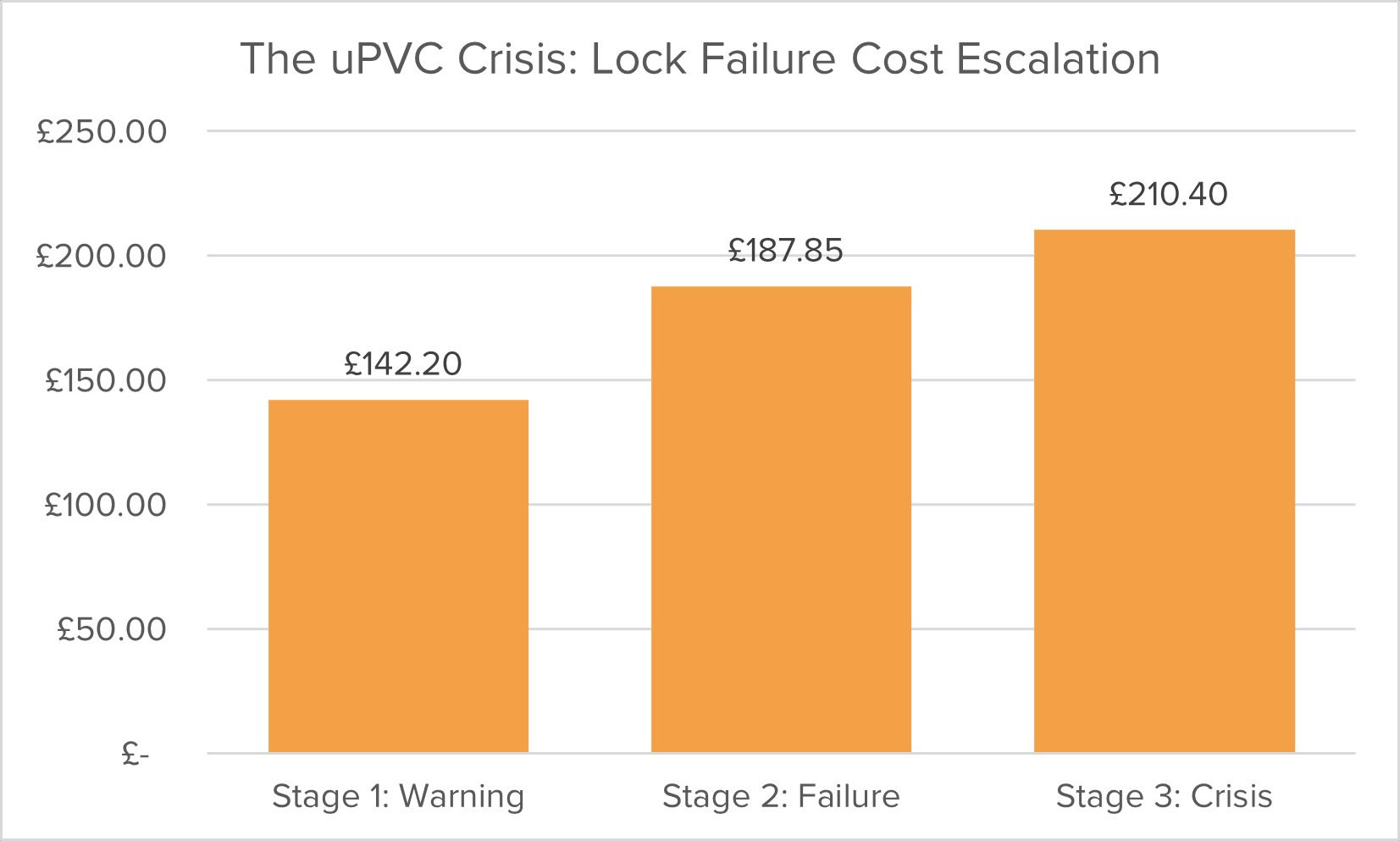
The Procrastination Tax
Not addressing your sticking door, and waiting until there is a total failure, means you’ll pay a significant premium. We’ve broken down the cost of waiting:
Failure Stage | Symptoms | Avg. Cost | Urgency | Repair vs. Replace |
Stage 1: Warning | Stiff handle, "crunchy" turn. | £142.20 | Low | 92% Repairable |
Stage 2: Failure | Lock seized / Door shut | £184.60 | High | 65% Replacement (Often requires new hardware) |
Stage 3: Crisis | Gearbox shattered (Locked). | £210.40+ | Critical | 85% Replacement (Often requires new more expensive hardware) |
You save an average of £68.20 by calling a local locksmith at stage 1 rather than waiting for the inevitable stage 3 problem.
Anatomy of a Failure: The Multipoint Vulnerability
The weakness lies in the multipoint locking system. Whilst these are high security when aligned, they are very complex with many different parts.
- Floppy Handle Warning: This is rarely a handle issue; it’s almost always the internal spring in the gearbox failing.
- Deadlock Effect: When a uPVC gearbox fails whilst the door is lock, it effectively deadlocks the door in the frame. This will require locksmith intervention to resolve the issue and get the door open.
uPVC Doors: Final Thoughts
The uPVC door is versatile, secure and easy to maintain, but it’s not a fit and forget. To avoid becoming a statistic in our next instalment of The uPVC Crisis, we recommend routine checks every April and October. If the handle feels heavy or hard to lock, the countdown has already started.
How to Avoid Becoming a Statistic: 3 Step Strategy
Our data shows that 54% of emergency failures were preceded by weeks of warning signs. You don’t have to be part of the “Stage 3 Crisis” statistics if you follow these three industry-standard checks:
1. The “Single Finger” Test (Seasonal Alignment)
Because uPVC expands in the heat and contracts in the cold, your door’s alignment changes throughout the year.
- The Test: With the door open, lift the handle to engage the bolts. It should move effortlessly. Now, close the door and try again.
- The Result: If you need more than a “single finger” of pressure to lift the handle when the door is closed, your frame has shifted.
- The Fix: Do not force it. Adjust the flag hinges (the hinges on the side of the door) with an Allen key to bring the door back into alignment with the locking keeps.
2. The “Bi-Annual Lubrication” (April & October)
Our Seasonal Risk Map shows that transitions into Summer and Winter are the danger zones.
- The Fix: Twice a year, apply a Teflon-based lubricant or a 3-in-1 oil to the locking points and the keyway.
- The Warning: Avoid WD-40 “Multi-Use” spray for long-term lubrication. Our study on WD-40 usage shows it can attract dust and grit over time, acting like sandpaper inside your gearbox and accelerating the “Stage 1” wear and tear.
3. Act on the “Floppy Handle” Immediately
A handle that doesn’t spring back to a horizontal position is the #1 predictor of a shattered gearbox.
- The Insight: This usually means the internal spring cassette has snapped. While the door still locks now, the mechanical stress is now being transferred directly to the gearbox.
- The Fix: Replacing a handle cassette costs roughly £40–£60. Replacing a shattered gearbox after a total lockout costs £200+.
Summary: The Homeowner’s Maintenance Calendar
- Spring (April): Lubricate all moving parts and perform the “Single Finger” alignment test.
- Summer (July/August): If the door “sticks” during a heatwave, do not force the handle. Cool the frame with a damp cloth or adjust the hinges.
- Autumn (October): Re-align the hinges for winter contraction to ensure the locking points engage smoothly.
Final Tip: If you have to “shoulder” the door or “lift” the handle with force, you are already at Stage 2. Call a professional locksmith now to save an average of £70 on an emergency call-out later this year.
Publishers note: All data has been processed to ensure individuals cannot be identified either directly or indirectly, in line with UK GDPR anonymisation standards.
Raw data: uPVC Crisis Data

Find your nearest Locksmith