
Cheap Cuts vs. Quality Keys: Why poor duplication leads to the 6.08% “Key Snapped” emergency rate

A key snapping inside a lock is not a situation anyone wants to end up in. According to our dataset key snapping accounts for 6.08% of all emergency locksmith callouts across the UK. A key breaks or snaps in a lock across approximately 3.81% of standard residential and commercial jobs, equating to more than 12,544 snapped-key incidents every year. This is roughly one every four to six hours.
However, the problem normally starts long before the key breaks. While excessive force can contribute to a snapped key, the condition and cut of the key itself plays a big factor. A poorly duplicated key can introduce tiny discrepancies that increase the resistance inside the lock.
How Can a Poorly Cut Key Lead to Failure?
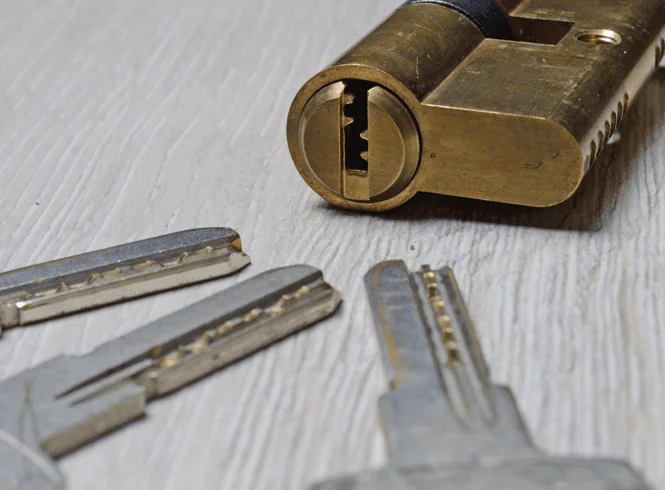
A key needs to match the internal mechanism of its lock with considerable precision, as its profile, cuts and dimensions all determine how smoothly it operates in the cylinder. When a duplicate is cut inaccurately, even small differences in alignment or calibration can affect the way the key interacts with the lock. The key may still fit and turn, but it can require more force than the correctly cut original. A discrepancy of even 0.1mm can become significant when combined with a mechanism that is already stiff or worn. This does not mean every minor discrepancy will cause a key to snap, but it does illustrate why accuracy matters.
Every time additional force is applied to overcome resistance, more torque is transferred through the key blade. Over time, that repeated stress can weaken the key and increase the risk of failure. This is particularly relevant to uPVC doors, as our data shows that 47.07% of all locksmith interventions involve uPVC doors. Euro-cylinder and multipoint locking systems can be especially sensitive to alignment and mechanical resistance, meaning a poorly cut duplicate may become a contributing factor when the locking mechanism is already under strain.
What Are the Warning Signs Your Key or Lock Is Failing?
A snapped key may feel sudden but locks often provide warning signs first. Our Wear and Tear Study found that 54.1% of repair jobs begin with “Problems Operating”. This includes stiff handles, stiff keys, and a crunchy or unusual turning sensation. These signs should not be dismissed as minor inconveniences, as a key that gradually becomes harder to turn may point to an issue with the lock, door alignment, gearbox, or another part of the mechanism. Continuing to use the key while applying increasing force can place unnecessary stress on the blade and increase the risk of it snapping.
An important rule to follow is: if the lock feels different, don’t compensate by using more force.
Can Hot Weather Increase the Risk?
The condition of a locking system can change with the seasons. Our Seasonal Risk Map shows that mechanical failures peak in August at 9.89%. One possible factor is the effect of summer heat on uPVC doors, as temperature changes can cause materials to expand and affect the alignment between the door and frame. This can place additional pressure on the locking points, making the mechanism harder to operate and increasing the resistance felt when turning the key.
When this happens, a chain reaction can occur, heat expansion leads to door misalignment, which creates increased resistance and places additional force on the key. If the key is also a duplicate that has not been cut accurately, the mechanical load can increase further. Hot weather does not automatically make keys snap, but seasonal movement can aggravate existing mechanical problems and create conditions where a key is more likely to be put under excessive stress. If your key becomes noticeably harder to turn during periods of extreme heat, forcing it could be the worst possible response.
How Much Can a Snapped Key Emergency Cost?
The attraction of a cheap duplicate is obvious, it costs less upfront, but the potential cost of ignoring a developing lock problem is considerably greater. The average cost of proactive lock diagnostics at £159.41. While the average emergency callout is £148.77 before any additional repair work is considered. Once a key snaps, the situation can become more complicated. The broken section may need to be extracted from the cylinder and, if the underlying mechanism has seized or been damaged, replacing the key alone will not solve the problem.
According to the operational data behind this analysis, 85% of Stage 3 cases require full hardware replacement, particularly where internal gearboxes have seized. That is the real cost of procrastination: a stiff lock might initially be an inconvenience, but a snapped key can leave you locked out. While a failed gearbox or damaged cylinder can turn that emergency into a much larger repair.
How to Prevent a Key From Snapping
Never force a key – If the handle feels heavy, stiff or spongy, stop rather than applying additional pressure.
Choose quality key duplication – Have replacement keys cut accurately by a reputable professional rather than choosing purely on price. Precision matters when a key is repeatedly operating a mechanical locking system.
Deal with sticky locks early – A key that is becoming increasingly difficult to turn is a warning sign, not something to ignore until the mechanism stops working altogether.
Consider an anti-snap cylinder – For uPVC doors, a suitable anti-snap security cylinder can provide an additional layer of protection against cylinder-snapping attacks and improve overall door security.

Chloe Harrison
Chloe is the Digital Marketing Executive at Keytek and specialises in creating informative home security content that helps homeowners tackle common lock and door issues with confidence. From practical how-to guides to expert security advice, Chloe focus' on delivering clear, reliable information that is easy to understand.
A Marketing graduate from the University of Kent, Chloe combines strong research skills with insights from Keytek's experienced locksmiths to produce accurate, up-to-date content that homeowners can trust.