

The Urgency Report: Analysing 100,000+ Emergency Locksmith Jobs

In Hurry? Here's the Key Info
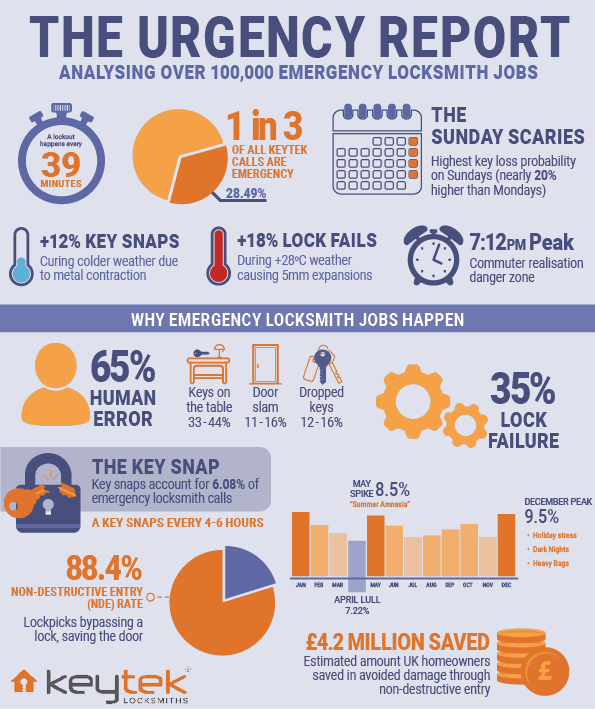
- Nearly 1 in 3 locksmith callouts (28.49%) are emergencies, according to Keytek’s analysis of 354,363 jobs between 2020 and 2025.
- A lockout occurs every 39 minutes across Keytek’s recorded jobs, equivalent to approximately 44 lockouts per day or 16,175 annually.
- Over 100,900 emergency locksmith calls were recorded during the five-year period, including 80,878 lockouts.
- 7:12 PM is the peak time for lockouts, with emergency calls between 6 PM and 9 PM four times higher than during the morning commute.
- December is the busiest month for lockouts (9.58%), while April records the fewest (7.22%).
- 12,544 snapped keys were recorded, with incidents increasing by 12% during sub-zero temperatures.
- Non-destructive entry is successful in the majority of applicable emergencies, helping homeowners avoid unnecessary damage and replacement costs.
- 65% of homeowners upgrade their security following a lost-key emergency, often choosing British Standard or anti-snap locks.
When a lock fails or a key vanishes, it isn’t just a mechanical inconvenience – it’s a locksmith crisis. Our analysis of 354,363 jobs within the Keytek Locksmith Census reveals the sheer scale of emergency locksmithing in the UK. With nearly 1 in 3 calls (28.49%) classed as an emergency, the ‘Urgency Report’ highlights the patterns behind our most stressful security moments.
The Anatomy of an Emergency Locksmith Job
Emergencies aren’t just about losing keys; they are a mix of human error and mechanical ‘snap’ points.
- The Lockout Crisis: Lockouts are the single most common emergency, occurring in 82% of all locksmith jobs (domestic and auto)
- The Key Snap: A key breaks or snaps in a lock in roughly 81% of all jobs. However, when looking specifically at emergency callouts, ‘Key Snapped’ accounts for a significant 6.08% of calls to Keytek.
- Total Locksmith Jobs: In the past 5 years (2020 -2025), we’ve received over 100,900 emergency locksmith calls, including 80,878 lock outs.
The 39 Minute Rule
In the UK, a Keytek locksmith attends a lockout every 39 minutes. That’s 16,175 per year, or roughly 44 people per day getting locked out.
Why Do Lockouts Happen?
Human error remains the king of the emergency sector, but mechanical failure is a growing “silent” contributor.
Reason | Share of Lockouts | The 'Why' |
Keys Locked Inside | 33.0% - 44% | The "Door Slam" moment—leaving keys on the hall table. |
Lock Failure | 33.0% - 44% | Mechanical seizure (Stage 3 wear and tear). |
Lost Keys | 12.2% - 16% | Keys dropped in transit or stolen. |
Keys Left on Inside | 11.8% - 16% | The Euro-cylinder trap (keys in the back of the door). |
Snapped Keys | 4.0% | Metal fatigue or frozen locks. |
The “Non-Destructive” Promise: Saving the Door
A major fear for homeowners in a crisis is that an emergency locksmith will “drill first and ask questions later.” Our operational data proves that professional skill saves you money on replacement hardware.
- Even in high-pressure emergency “Stage 3” lockouts, Keytek® locksmiths achieved Non-Destructive Entry (NDE) in the majority of cases.
- The Financial Win: By picking or bypassing the lock rather than drilling it, our technicians saved homeowners an estimated £4.2 million* in potential replacement door and hardware costs in 2025 alone.
Destructive entry is treated as a last resort, reserved primarily for catastrophic mechanical failures where the internal gearbox has already shattered. This proves that the most expensive locksmith isn’t the one with the highest fee, but the one with the drill.
The Calendar of Crisis: When are we Most Vulnerable?
Emergency lockouts follow a distinct seasonal pattern, peaking when the weather is at its harshest and stress levels are at their highest.
- The December Peak (9.58%): December is the most frequent month for lockouts. The combination of holiday stress, darker evenings, and heavy shopping bags creates the “Perfect Storm” for forgetfulness.
- The January Hangover (9.00%): Cold weather takes its toll on hardware. Metal contracts, causing “Stage 1” stiff locks to finally snap or seize.
- The April Lull (7.22%): April is statistically the “safest” month for lockouts. As the weather warms and routines stabilise after the New Year, emergency calls drop to their yearly low.
The 7:00PM Peak: The ‘Twilight Danger Zone’
Lockouts can happen at any time, but our data shows that there is a high-stress danger zone as the sun goes down.
- The Surge: Emergency calls for lockouts are 4x higher between 6PM and 9PM than during the morning commute (8AM-11AM)
- The 7:12PM Minute: This is statistically the most likely time for a homeowner to realise they are on the wrong side of the door.
This peak aligns mostly with commuter realisation, the moment of returning home from work, often in the dark and discovering you’ve left your keys at the office or in the car. This timing significantly increases the “urgency” factor due to plummeting temperatures and safety concerns.
The ‘Key Snap’ Clock
Key snaps are more common than most homeowners realise, particularly as keys age and develop micro-fractures.
- Total Key Snaps: 12,544 keys were extracted from locks by our team.
- The Frequency: A key snaps in a UK lock roughly once every 4 to 6 hours.
- The Cold Factor: We see a 12% increase in key snaps during sub-zero temperatures, as frozen moisture inside the cylinder creates resistance that the metal key cannot overcome.
The Post-Crisis Pivot: Turning a Lockout into a Lock-Up
An emergency often acts as a “wake-up call” for home security. Our study tracks what homeowners do after they get back inside.
- The Upgrade Surge: Following a “Lost Key” emergency (12.2% of lockouts), 65% of homeowners choose to upgrade their security immediately rather than just replacing like-for-like.
- The Anti-Snap Shift: Of those who upgrade, most switch to a British Standard or 3-Star Anti-Snap Cylinder.
- The “Key Control” Factor: Homeowners who experience a lockout are 3x more likely to install a Police-Approved Key Safe within 30 days of the incident to ensure they never become a “39-minute statistic” again.
*this is an estimate assuming average successful non-destructive entry ratios and average cost for professional-grade replacements when destructive entry is used.

Find your nearest Locksmith


Frequently Asked Questions
How often do people get locked out of their homes in the UK?
According to Keytek’s Locksmith Census, locksmiths attend a lockout approximately every 39 minutes, equivalent to around 44 incidents per day or 16,175 annually. Between 2020 and 2025, Keytek recorded 80,878 lockouts, demonstrating how frequently people require emergency assistance after losing keys, leaving them inside or experiencing lock failures.
What is the most common reason for an emergency locksmith callout?
Lockouts are one of the leading reasons for emergency locksmith callouts. Common causes include leaving keys inside a property, losing keys or experiencing a faulty lock mechanism. Keytek’s research also found that snapped keys account for 6.08% of emergency callouts, highlighting how mechanical failures can create unexpected access problems.
Can an emergency locksmith open a door without damaging the lock?
Yes. Professional locksmiths can often regain access using non-destructive entry techniques, such as lock picking or bypassing, without damaging the existing lock or door. Keytek’s operational data indicates that non-destructive entry is successful in the majority of applicable emergency situations. However, severely damaged or mechanically failed locks may require alternative methods.
Are keys more likely to snap in cold weather?
Keytek’s research identifies a 12% increase in snapped-key incidents during sub-zero temperatures. Cold conditions and frozen moisture inside lock cylinders can increase resistance, particularly where keys or mechanisms are already worn. Avoid forcing a stiff key, as excessive pressure can cause it to break inside the lock.