
How to Open a Jammed Door Lock

How to Open a Jammed Door Lock (Step-by-Step Guide)
If you need to know how to open a jammed door lock, start by working out what’s stuck: the key, handle or latch. Push the door towards the frame to take the pressure off the lock, apply a suitable lock lubricant if needed, and turn the key gently. If you’re outside, try any other doors you have a key for first.
If these steps do not work, stop rather than forcing the lock. This guide applies only to your own door; if you are outside or have no key, use the relevant guidance below. A locksmith may be able to open the lock without damaging the door.
Work out what’s jammed
Different problems need different solutions. Find the symptom that best matches your door to see what you can safely try.
What's happening | Likely cause | Try this | Stop and call a locksmith if |
Key won't go into the lock | Wrong or damaged key, or dirt or ice in the keyway | Check the key, try the spare, lubricate the keyway (steps 1 and 3) | Something is lodged inside, or a piece of broken key is stuck |
Key goes in but won't turn | Door pressing on the bolts, or dirt or wear inside the cylinder | Push the door into the frame while turning (step 2), then lubricate (step 3) | It only turns with real force |
Key turns but the door won't open | Latch or bolt caught in the frame, or the door has dropped on its hinges | Push and pull the door gently while working the handle (step 4) | The latch doesn't move at all when you turn the key or handle |
uPVC handle won't lift or won't push down | Door out of line, or a worn gearbox in the multipoint lock | Close the door fully, push it towards the frame and try again | The handle feels floppy, grinds or springs back |
Key stuck in the lock | Worn key or cylinder, or the key isn't back in its starting position | Turn the key back to its starting position, lubricate and ease it out | It won't move without twisting hard |
If your key is stuck and won’t come out, see our guide on how to get a stuck key out of a lock.
Step by step
These steps are intended for your own door. Work gently at every stage; the aim is to free the lock, not overpower it.
Step 1: Check the key
Make sure you’re using the correct key and check for bends, cracks or signs of wear. If you have a spare, try that instead. A worn key, particularly one cut from another copy rather than the original, can be why a lock suddenly stops turning.
Step 2: Take the pressure off the door
If your door has dropped, swollen or moved slightly in its frame, the bolts may be pressing against the keeps, preventing the key from turning.
Push the door firmly towards the frame while gently turning the key. If the door opens outwards, try pulling it towards you instead. On a uPVC door, turn the key fully before pushing the handle down.
Step 3: Lubricate the lock
Dust, dirt and old grease can make a lock stiff. Apply a small amount of the lubricant recommended by the lock manufacturer, usually a dry PTFE spray or graphite powder, into the keyway. Slide the key in and out a few times before gently trying to turn it again.
Avoid standard WD-40 and household oils, which can leave residue and make the lock stickier over time.
Step 4: Work the handle and key together
With the key turned as far as it will comfortably go, gently move the handle while pushing and pulling the door in small movements. This may free a latch that’s caught against the frame.
Keep your movements small and steady. Slamming, kicking or shouldering the door can damage the frame and lock, turning a minor problem into a more expensive repair.
Step 5: Try from the other side
If someone is inside, ask them to try their key or thumb turn. A lock that won’t turn from one side may still operate from the other, allowing you to open the door and arrange a repair.
Step 6: Know when to stop
If the key or handle needs real force, or the lock gets worse rather than better, stop there. Forcing it could damage the internal mechanism.
How to open a jammed door from the outside
When you can access only the outside of the door, first rule out alternative ways in and simple issues that do not require forcing the lock.
Before trying anything else, work through these checks in order:
- Try another entrance. Check whether you have a key for the back door, patio door or internal garage door.
- Contact someone with a spare key. They may be able to let you in or help you work out what’s wrong.
- Check whether a key is in the inside of the lock. On many standard euro cylinders, a key left in the inside can prevent another key from working outside.
- Work through steps 1 to 4 above. Check your key, take pressure off the door, lubricate the lock if appropriate and gently work the handle.
We don’t recommend the credit card, hairpin or screwdriver tricks you may have seen in films and online videos. These rarely work on modern locks and can damage the door, frame or lock. Never attempt to get past a lock on a door that isn’t yours.
Locked out with no key at all?
If you’ve lost your key or it’s broken, you’re dealing with a lockout rather than simply a jammed lock. Read our locked out of your house guide for advice on what to do next. A locksmith can often gain entry using non-destructive methods, so a new door or frame may not be necessary.
uPVC door lock jammed?
A uPVC door lock mechanism that’s jammed may have a mechanical fault rather than a problem with the keyway.
Most uPVC doors use a multipoint locking mechanism, where one handle and key operate several hooks, rollers or bolts along the door edge through a gearbox inside the door. This provides extra security, but a fault in one part can stop the entire mechanism from working.
Our wear and tear analysis of 354,363 locksmith jobs found that uPVC doors were 2.7 times more likely to suffer mechanical seizure than traditional timber doors. Around 31% of uPVC failures were linked to doors dropping on their hinges.
Look out for these warning signs:
- The handle is harder to lift than it used to be, or the door only locks when you push it.
- The handle feels loose or floppy. Our data found that 68% of uPVC gearbox failures were preceded by a floppy handle for at least 14 days.
- The door catches on the frame, or there’s a visible gap at the top or bottom.
- You hear grinding or clicking inside the door when turning the key.
If your handle is difficult to lift, see our advice on a uPVC door handle that won’t lift to lock.
If the door won’t open at all, don’t keep forcing the handle. Our uPVC lock specialists can help free the mechanism and replace the gearbox if necessary.
When to stop and call a locksmith
Some problems can be resolved with a few careful checks, but others need professional attention. Stop and call a locksmith if:
- The key or handle only moves with real force.
- The key has bent or looks likely to snap.
- The uPVC handle is floppy, grinds or springs back.
- The latch or bolts don’t move when you turn the key.
- You’re locked out or locked in, and the steps above haven’t worked.
Forcing a difficult lock can make the problem much worse. Our wear and tear study found that continued force increases the risk of the internal gearbox shattering by 400%.
The good news is that early intervention can often save money. According to the same study, 92% of early-stage problems can be resolved through alignment, lubrication or servicing, at an average cost of £142.20. By comparison, catastrophic lock failure costs an average of £187.85 to £210.40.
Where possible, our locksmiths aim to open a jammed lock without damaging your door and explain the problem before carrying out any repair.
If your key has already snapped, read our guide on how to get a snapped key out of a lock.
Why do door locks jam?
Understanding what causes a lock to jam can help you prevent it from happening again.
The door has moved out of line
Doors can drop on their hinges, frames can shift and timber can swell in damp weather. When this happens, the latch and bolts may no longer line up with the keeps in the frame. This is one of the most common causes of problems with uPVC doors.
Dirt, debris and old lubricant
Dust, grit and old grease can build up inside the keyway and locking mechanism, making the key difficult to turn. Cleaning and lubricating external locks once or twice a year with a suitable product can help prevent this.
Weather
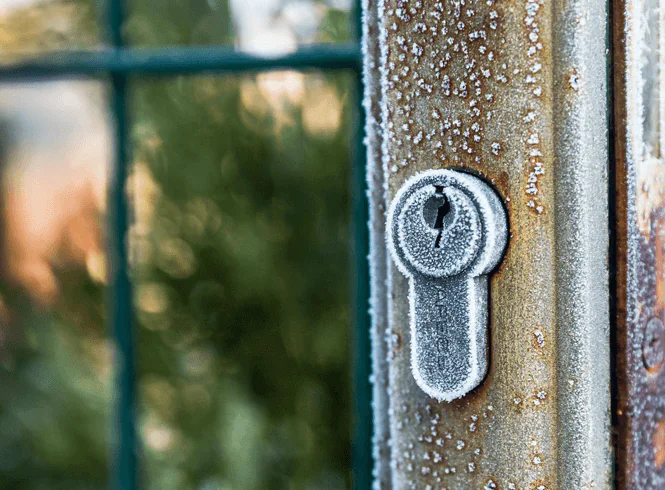
Timber doors can swell and stick in damp or humid weather. In winter, water can freeze inside the lock itself, so follow our advice on how to stop your locks freezing.
Poor fitting or worn hinges
A lock or keep fitted slightly out of line, or hinges that have worn or sagged, can cause sticking that gets worse over time. A locksmith can assess the alignment and adjust the door or replace worn hinges where necessary.
How to stop your door lock jamming again
A few simple habits can help keep your lock working properly:
- Lubricate external locks once or twice a year with the product recommended by the manufacturer.
- Keep the keyway clean and wipe wet keys before using them.
- Don’t ignore a stiff lock; it rarely fixes itself.
- Get a dropped uPVC door adjusted before the handle starts to struggle.
- Replace worn keys by having a new one cut from the original, rather than from another copy.
For more advice, read our door lock maintenance guide.

Max Kelly
Max is a home security how-to expert with extensive knowledge of securing doors, windows, and entire properties. With years of experience in the field, he specialises in easy-to-follow DIY solutions for common security issues. His practical, step-by-step guides empower homeowners to strengthen their safety measures with confidence and ease.